Discover with
Encyclopedia
Explore an extensive collection of garments curated by the community, featuring tailored filters and distinctive viewpoints.
Discover with
Encyclopedia
Explore an extensive collection of garments curated by the community, featuring tailored filters and distinctive viewpoints.

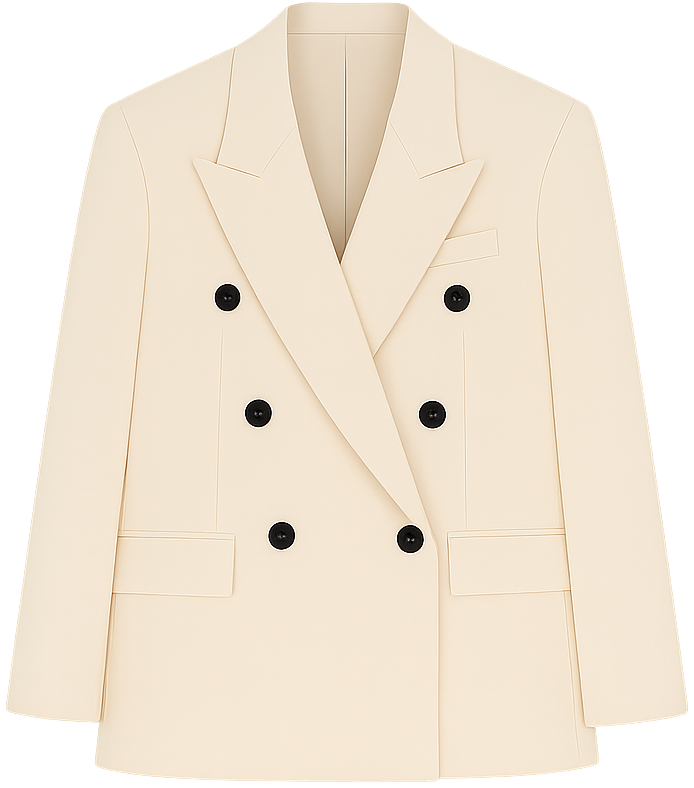
The same factories that produce for houses like Celine and Balenciaga can produce this piece, directly to you
GABI
Online now
Blazer
The same factories that produce for houses like Celine and Balenciaga can produce this piece, directly to you
GABI
Online now
Blazer
In 1860, a tailor on Savile Row made a jacket for the Prince of Wales. No tails. No decoration. Just a clean, structured jacket with a notch lapel and two buttons. Everyone said it was too plain. He wore it anyway. That jacket became the blazer. One hundred and sixty years later, every power suit, every fashion-week moment, every oversized street-style co-ord traces its DNA to that plain jacket. The only thing that separates a $50 version from a $5,000 version is what is inside.
The Blazer -- "The Only Thing Separating a $50 Version from a $5,000 Version is What is Inside"
The blazer traces its commercial origin to mid-19th century Savile Row, where London tailors developed the lounge suit jacket as an alternative to the formal frock coat. A single-breasted, unstructured-shoulder jacket without tails, worn initially for leisure, it evolved into the standard jacket for both business and casual dress across the 20th century. The construction architecture -- canvas, interlining, lining, pad-stitched lapel -- did not change significantly until the 1970s, when fusible interlining became commercially available at scale.
A blazer costs between $54 and $450+ landed. Affordable China fused poly/viscose: ~$54. Premium Turkey half-canvas wool/poly: ~$122. Premium Portugal GOTS linen unlined: ~$84. Luxury Italy full-canvas Super 100s: $350-450+. Construction method is the primary cost driver.
Fused: adhesive-bonded interlining, fast, loses structure over time -- bubbling is the characteristic failure. Half-canvas: natural-fibre canvas chest piece sewn into the jacket front, lasting drape and structure. Full-canvas: entire front hand-built from canvas, moulds to wearer, indefinitely alterable. A half-canvas blazer in modest fabric outperforms a fused blazer in premium fabric.
Bemberg cupro is the industry standard above affordable tier: reduces static, breathes, slips on shoulder cleanly. Polyester at affordable only. Silk at luxury. Unlined or half-lined for summer/fashion blazers. Never specify polyester on a premium-positioned blazer -- it is detectable immediately.
Fusible interlining transformed the blazer market. A bonded adhesive interlining pressed onto the face fabric provides structure without the skill or time of canvas construction. It allowed factories without specialist tailoring training to produce blazers quickly and cheaply. The quality compromise was real: a fused blazer loses its structure as the adhesive weakens with wear and washing. But the commercial accessibility of fused construction made the blazer a mass-market garment rather than a luxury item.
Half-canvas construction became the premium commercial standard: a natural-fibre canvas chest piece sewn into the jacket front, providing most of the drape and lasting structure of full canvas at significantly lower CMT. Most contemporary premium blazers at the $300-600 retail tier are half-canvas. Full-canvas construction -- the Savile Row and luxury Italian tailoring standard -- requires a skilled tailor to pad-stitch the lapel by hand and build the garment from the inside out. The result moulds to the wearer over time and can be altered and relined indefinitely.
For independent creators, the oversized blazer sits at the intersection of fashion and tailoring without requiring full canvas complexity. Unlined or half-lined with minimal interlining, it is accessible at premium tier without specialist tailoring factory requirements. The co-ord blazer -- matching blazer and trouser or short from the same fabric lot -- is one of the strongest commercial structures in the DTC market.
A tailoring factory -- not a woven shirt or jersey factory. Must have: canvas infrastructure, fusing press, collar shaping machinery, pad-stitching capability. Always confirm tailoring capability and request previous blazer samples before brief submission.
Specify woven fusible interlining. Fuse at minimum 150C for 3 minutes under even pressure. Test 20 wash cycles at 30C before bulk approval. Or: specify half-canvas construction to eliminate the risk entirely. A half-canvas blazer cannot bubble.
Recessed pockets framed by a narrow fabric welt. Standard on tailored blazers. Technically demanding: tolerance +/-1mm, bar-tack at both ends. Patch pockets are an accessible alternative for casual/oversized blazers at $3-6 less CMT.
Yes -- blazer and trouser or blazer and short. Follow Co-ord Set #035 dye lot rules: single fabric lot from same dye batch. Fit both pieces on body together before bulk approval. This is one of the strongest commercial structures in the DTC creator market.
Oversized unlined or half-lined blazer in GOTS cotton/linen, from Turkey or Portugal. Minimal construction, no canvas, half-lining at back only. Lands $65-90. Retails $250-320. The story is entirely in the fabric and the silhouette.
Casual/fashion: cotton twill, linen, cotton/linen blend. Smart-casual: wool/poly blend. Luxury: 100% wool or Super 100s+. Technical: stretch suiting for travel. Minimum 250 GSM for structure. Always specify GSM, composition, and weave on the tech pack.
GOTS x1.23 for organic cotton suiting. RWS x1.08-1.12 for wool. OEKO-TEX all. GRS x1.15-1.20 for recycled poly suiting. Lining: OEKO-TEX -- Bemberg is direct skin contact. Certification on lining matters as much as on face fabric.
HS 6203 for mens tailored jackets. HS 6204 for womens tailored jackets. Unisex: confirm with customs broker based on cut and labelling. Duty rates vary significantly by fabric content.
China for all tiers at accessible MOQ. Turkey for EU-delivery premium. Portugal for Made in Europe. Italy for luxury full-canvas. Eastern Europe for EU production at more accessible CMT than Italy. First blazer: Portugal 100-150 units unlined, or Turkey 100-200 units fused.
Fleece Jacket