Discover with
Encyclopedia
Explore an extensive collection of garments curated by the community, featuring tailored filters and distinctive viewpoints.
Discover with
Encyclopedia
Explore an extensive collection of garments curated by the community, featuring tailored filters and distinctive viewpoints.

The same factories that produce for houses like Celine and Balenciaga can produce this piece, directly to you
GABI
Online now
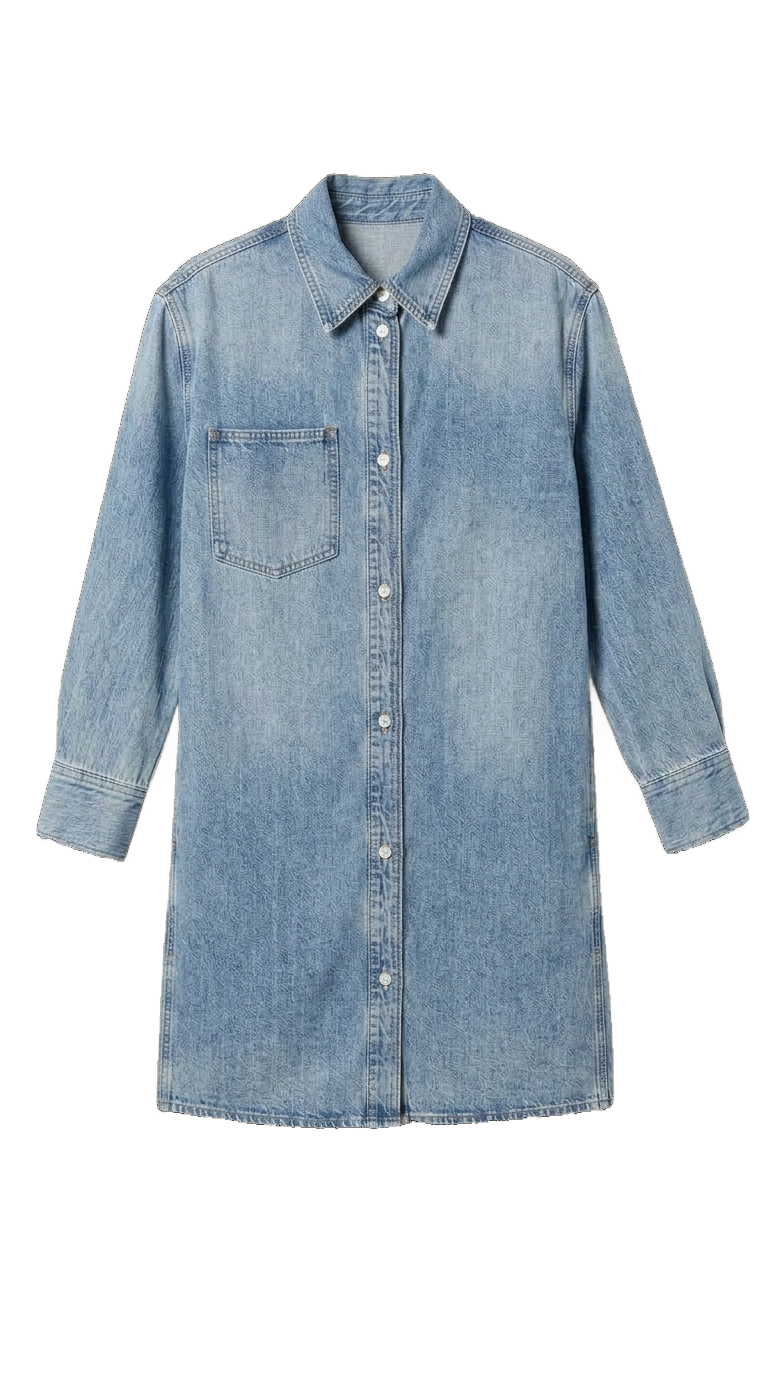
Denim Shirts Dress
The same factories that produce for houses like Celine and Balenciaga can produce this piece, directly to you
GABI
Online now
Denim Shirts Dress
The denim shirt is the most underestimated garment in the denim family. It uses the lightest fabric. It has the most construction complexity. It works as a shirt, a jacket, and a layer simultaneously. Levi's made it iconic. Ralph Lauren made it expensive. And now every brand from H&M to Loro Piana has one. The blueprint is the same. The only variable is what it's made of.
The Story of the Denim Shirt — "The Garment That Works Twice"
The denim shirt began where denim always begins: with work. The Western shirt — pearl snap buttons, two chest pockets, pointed yoke — was the uniform of the American ranch hand. Built for durability in the same spirit as jeans, but worn above the waist. The denim version offered the same indigo twill construction in a lighter weight: the same toughness, the same fade character, but more breathable and easier to move in than heavyweight denim.
Levi's produced their first denim shirts in the 1920s and 30s to pair with their jeans — creating the full denim suit, the tenue du travail that French workers had worn in the mid-19th century and that would eventually become the most subversive fashion statement of the 20th.
A denim shirt costs between $27 and $57 per unit landed. An affordable classic shirt in lightweight denim from China with enzyme wash lands at approximately $27. A premium GOTS organic overshirt from Turkey with stone wash lands at around $57. Despite lower CMT than a jacket, the denim shirt has high fabric cost relative to CMT due to its 1.95m consumption — the highest in the denim family.
Lightweight denim at 6–9 oz (200–300 GSM) is the standard for classic shirts and chambray styles — softer, more breathable, and easier to construct with collar and cuff precision. Midweight denim (10–12 oz) is appropriate for overshirts and shackets where more structure is required. Heavyweight denim should never be used for shirts.
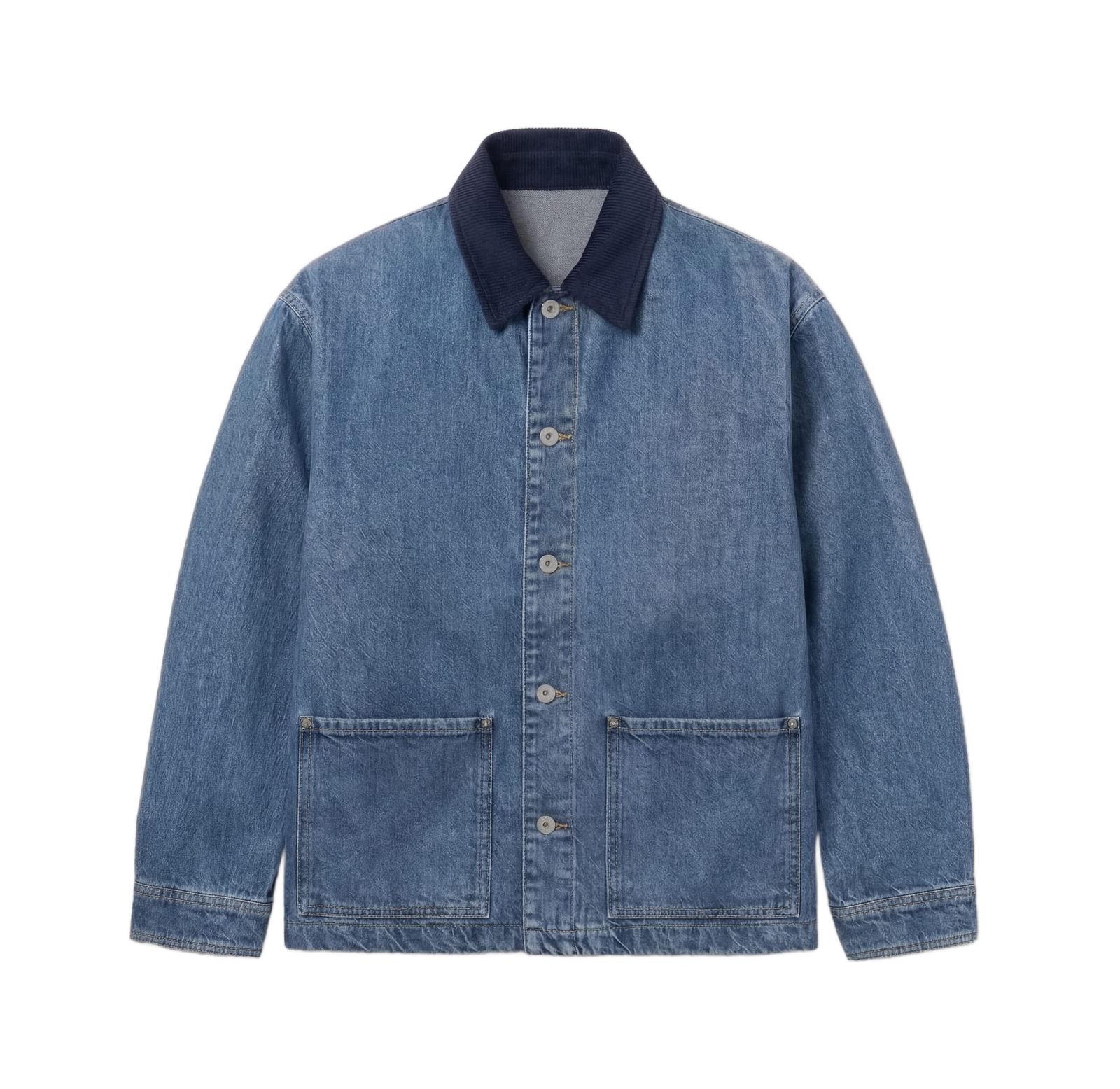
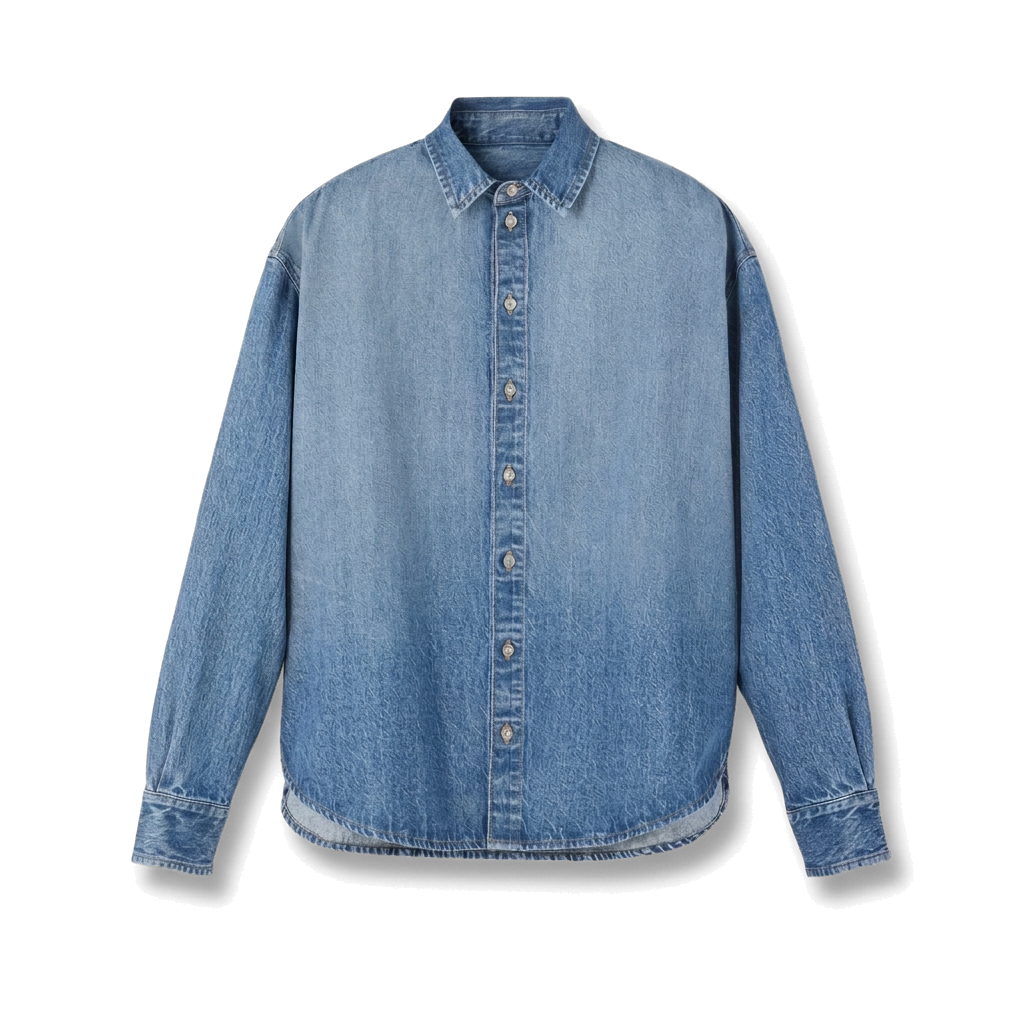
A denim shirt is worn as a shirt — tucked or untucked, with collar, cuffs, and standard shirt construction. An overshirt, or shacket, is a longer, more relaxed garment worn open over a T-shirt as a lightweight jacket substitute. Overshirts use midweight denim for structure, have a simpler construction, often with no structured cuff or collar stand, and command a higher retail price due to outerwear positioning. CMT difference: shirt $7.50 affordable vs overshirt $10.00 affordable.
The full denim look — shirt and jeans together — was famously banned by some venues in the 1970s as the garment combination most associated with juvenile delinquency and working-class rebellion. By 1976, Elvis Presley and Johnny Cash were both photographed in denim shirts. The ban did not survive contact with the culture.
By the 1980s and 90s, the denim shirt had been adopted by everyone from rodeo competitors to fashion photographers to the burgeoning preppy movement that found something clean and deliberate in the chambray button-down. Ralph Lauren made the denim shirt aspirational — adding it to his vision of an idealised American West that had nothing to do with actual ranching and everything to do with a certain kind of ease.
The contemporary overshirt — longer, more relaxed, worn open over a T-shirt as a lightweight jacket substitute — is the denim shirt's most commercially successful recent iteration. CMMN SWDN. Our Legacy. A.P.C. Barbour. Every brand that understands layering has an overshirt in denim or chambray in its core range.
The denim shirt is the only item in the denim family that requires full shirt construction knowledge: collar, collar stand, cuff, cuff placket, sleeve placket, button placket, chest pockets. The CMT is higher relative to fabric consumption than any other denim item. But the retail price reflects this — and the layering utility justifies a repeat purchase that few other garments can match.
The denim shirt belongs to everyone. The Western blueprint has no patent. The overshirt silhouette has no copyright. The only barrier is the knowledge to spec it correctly and the access to the right lightweight denim or chambray fabric at the right price.
A denim shirt uses 1.95m of fabric at size M — the highest consumption in the denim family — because it requires fabric for the full body front and back, two long sleeves with plackets, collar, collar stand, cuffs, and two chest pockets. This makes fabric cost the primary cost driver in denim shirts rather than CMT as in simpler garments.
MOQs for denim shirts are 300 to 1,000 units at standard factories. Through the Sparkit network they start at 50 to 150 units. Denim shirts can be combined on a cutting run with other lightweight denim items at the same factory, reducing per-unit costs across all styles.
Denim shirts take 38 to 97 days from order to UK delivery. Portugal is 38 to 65 days. Turkey is 40 to 62 days. China is 67 to 97 days. Shirt construction is more time-consuming than jeans or shorts due to the collar, cuff, and placket complexity, so factor an additional 3 to 5 days into production timelines relative to bottoms at the same factory.
Affordable: standard resin or plastic buttons. Premium: corozo buttons, which are the most sustainable natural button material and signal quality. Luxury: mother-of-pearl or horn buttons. For Western shirts, pearl snap closures are the authentic hardware choice. Specify button attachment and a pull-test in QC for all button types.
A Western denim shirt adds pointed yoke pieces at front and back, pearl snap closures instead of sewn buttons, and often piping at yoke seams and pocket edges. The pointed yoke requires more precise pattern cutting and seaming. Pearl snaps replace standard buttons but add $0.80–$1.50 per shirt in hardware cost. CMT is approximately 15–20% higher than a standard shirt.
Enzyme wash at roughly $1.50–$3.00 per unit is the most appropriate wash for lightweight denim shirts because it softens the fabric and reduces stiffness without significant fading, which suits a cleaner button-down aesthetic. Stone wash is appropriate for a more casual or vintage overshirt aesthetic. Raw or dark wash suits fashion-forward positioning where structured, indigo-rich fabric is the statement.
Yes, and this is strongly recommended. A classic shirt and an overshirt can use different fabric weights but often share the same wash house and sometimes the same factory cutting run. A combined order reduces per-unit sampling costs and helps negotiate better fabric pricing across the two yardage requirements.
The Sparkit Denim Engine locks overshirt CMT at $10.00 affordable, $14.50 premium, and $28.50 luxury. This is higher than a classic shirt at $7.50, $11.00, and $20.00 because overshirts typically have more pockets, heavier construction, and sometimes additional details such as a patch back yoke or interior features. The overshirt's higher retail positioning makes the CMT premium commercially justifiable.
Denim shirts use HS code 6205 for men's and unisex woven shirts or 6206 for women's woven shirts. Use 6205 for unisex and men's styles. Use 6206 for women's-specific constructions. Overshirts that function as outerwear may classify under 6201 or 6202, so confirm with your customs broker before production.