Discover with
Encyclopedia
Explore an extensive collection of garments curated by the community, featuring tailored filters and distinctive viewpoints.
Discover with
Encyclopedia
Explore an extensive collection of garments curated by the community, featuring tailored filters and distinctive viewpoints.

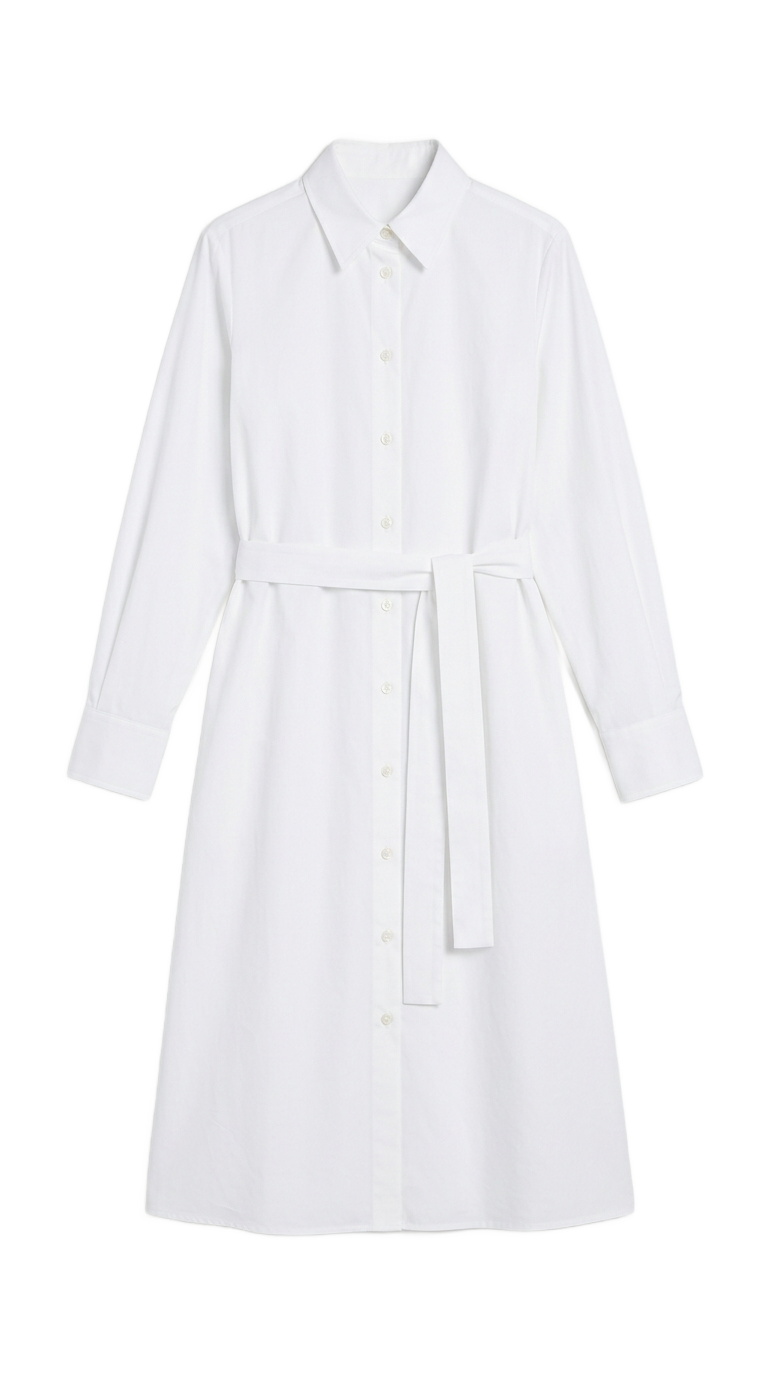
The same factories that produce for houses like Celine and Balenciaga can produce this piece, directly to you
GABI
Online now
White Belted Shirt Dress
The same factories that produce for houses like Celine and Balenciaga can produce this piece, directly to you
GABI
Online now
White Belted Shirt Dress
There are approximately 2 billion poplin shirts produced every year. They are worn in boardrooms, on beaches, under suits, over swimwear, tucked, untucked, ironed, and deliberately crumpled. The construction has not changed in 150 years. The fabric has not changed in 150 years. And yet a $15 poplin shirt and a $400 poplin shirt are completely different objects. The difference is not the design. It is the specification.
The Story of the Poplin Shirt — "The Most Specified Garment on Earth"
The poplin shirt is the most thoroughly specified garment in the history of fashion. No other garment has generated more technical vocabulary, more quality tiers, more obsessive consumer attention to detail. Thread count. Yarn count. Two-ply. Single-needle stitching. Mother-of-pearl buttons. Collar stays. Gauntlet button. Half-lining. Full lining. Fused collar. Sewn collar. The poplin shirt is a garment where the differences between a $30 version and a $400 version are entirely legible to anyone who knows what to look for — and almost invisible to everyone else.
A poplin shirt costs between $18 and $75 per unit landed depending on fabric weight, dye method, finish, and factory region. An affordable solid-colour shirt from Bangladesh lands at approximately $18. A premium GOTS yarn-dyed stripe shirt from Turkey lands at approximately $38 — the stripe adds around $7 to the landed cost through yarn dye multiplier, pattern matching yardage, and CMT uplift. A luxury GOTS non-iron shirt with French seams from Portugal lands at approximately $73.
Poplin is a plain-weave cotton fabric with a fine horizontal rib created by using a slightly heavier weft yarn than warp. The result is a smooth, crisp fabric that takes dye evenly, holds structure well, and drapes cleanly. It is the primary shirting fabric in the world. In woven fabric terms, it is the cotton equivalent of jersey in the knit family — the standard, the baseline, the reference point from which all other shirting fabrics are measured.
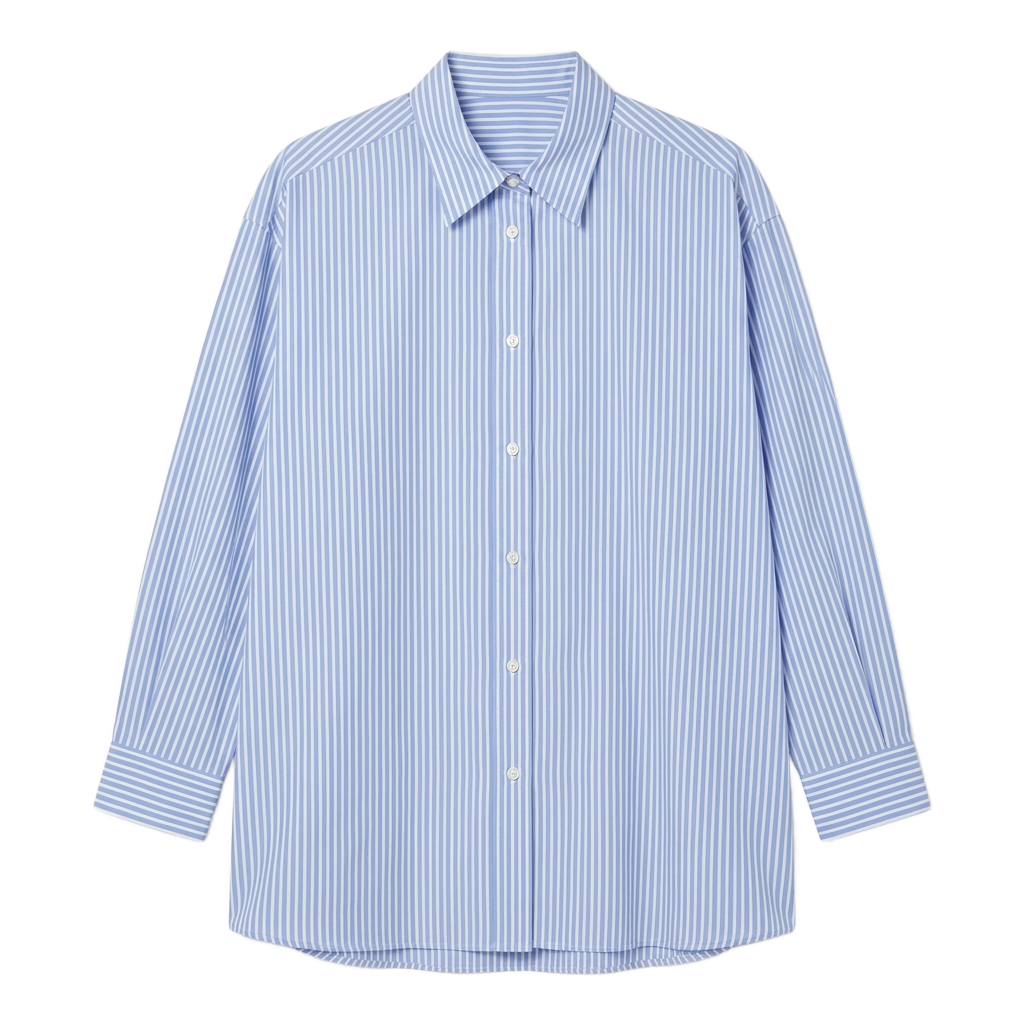
Piece-dyed poplin is woven first and then dyed — the result is always a solid colour. Yarn-dyed poplin has the yarn dyed before weaving, which allows patterns to be woven into the fabric: stripes, checks, plaids, and ginghams. Yarn-dyed fabric carries a ×1.175 multiplier on the Sparkit Poplin Engine compared to piece-dyed. Stripes and checks also require a pattern matching consumption multiplier of ×1.15 on top — 15% more fabric is needed per shirt to align the pattern at seams and yokes.
This is what makes it one of the most commercially important garments ever made, and one of the most technically demanding to build well. The fabric itself — poplin — predates the shirt by centuries. The word derives from the French papeline, a silk-and-worsted fabric produced in Avignon, France, which was the papal seat in the 14th century. The papal connection gave the fabric its name. The construction — a plain weave with a fine horizontal rib created by using a heavier weft yarn than warp yarn — gave it its properties: smooth, structured, breathable, and exceptional at holding colour.
By the 19th century, poplin had migrated from silk to cotton, and from luxury fabric to everyday shirting. The Industrial Revolution made fine cotton yarn abundant and cheap. The plain weave was efficient to produce at scale. And the resulting fabric — crisp, cool, smooth — was exactly what a new class of urban professionals needed to wear to their offices, their banks, their courtrooms.
The white poplin shirt became the uniform of professional life. It was not fashion. It was infrastructure. For most of the 20th century, the poplin shirt was the domain of specialist shirtmakers — Charvet in Paris, Turnbull & Asser in London, Brooks Brothers in New York. These were houses that understood the fabric intimately: how different yarn counts changed the hand feel, how thread count affected drape, how the collar construction determined whether a shirt looked expensive or merely white.
Then mass manufacturing arrived, and the poplin shirt split into two worlds. In the first world: the fast fashion poplin shirt. Woven from lower-count yarn, cut on the bias to save fabric, assembled with fused collars and machine-stitched buttonholes, finished with polyester buttons. Correct from a distance. Wrong in the hand.
In the second world: the shirt that the specialist houses had always made. High-count two-ply yarn, single-needle side seam, hand-sewn collar, gauntlet button, mother-of-pearl. Built to last ten years and improve with washing.
The contemporary market has added a third world: the premium-positioned DTC poplin shirt. Brands like Proper Cloth, Ledbury, Charles Tyrwhitt, and Kamakura Shirts have systematised quality at scale — offering made-to-measure or semi-bespoke poplin shirts at $100–$300 with transparent specification. The consumer who buys these shirts knows exactly what they are getting. And increasingly, they know exactly what they are not getting from a $30 fast fashion alternative.
The innovation chapter of the poplin shirt is only beginning. Hemp and nettle poplin — woven from bast fibres with zero irrigation and no pesticides — are commercially available. The hand feel is different from cotton poplin: slightly more textured, with the structural integrity of linen but the smoothness of a well-woven cotton. At a ×1.35 innovation multiplier, a hemp or nettle poplin shirt costs approximately $10–$15 more to land than a conventional cotton equivalent — and carries an agricultural story that no certification programme can replicate.
The poplin shirt will be produced in its billions for as long as professional life requires a collar. The question is which billions are built right.
Non-iron finish is a resin crosslinking treatment applied to the fabric that gives the shirt high crease resistance — it can be worn and even washed without ironing and retains a relatively crisp appearance. It is the highest-cost finish adder in the Sparkit Poplin Engine at $1.65 per metre. On a shirt using 1.60m of fabric, non-iron finish adds $2.64 to the unit cost. It is a significant consumer benefit that commands a retail premium.
Lightweight poplin at 90–120 GSM is the commercial standard for classic and slim-fit shirts — it has the right balance of structure and drape and is appropriate for year-round shirting. Ultra-light 70–90 GSM is for summer and beach-adjacent drops only. Midweight 120–150 GSM is appropriate for overshirts and structured shirt-dresses. Heavyweight 150–190 GSM suits workwear positioning only.
Standard MOQs for poplin shirts are 500 to 2,000 units in Bangladesh and 300 to 1,000 in China. Through the Sparkit network, MOQs start at 50 to 200 units depending on region. Yarn-dyed fabrics typically require a minimum fabric yardage purchase at the mill level — confirm with the factory whether the yarn-dyed fabric is held in stock or needs to be woven to order, as this affects both MOQ and lead time significantly.
Poplin shirts take 37 to 111 days from order to UK delivery. Turkey and Portugal are the fastest at 37 to 65 days total. China is 62 to 92 days. Bangladesh and India are 67 to 111 days. Yarn-dyed fabric orders add 3 to 6 weeks if the fabric needs to be woven to order — always confirm whether the factory has the yarn-dyed fabric in stock before committing to a production timeline.
Affordable: standard resin buttons. Premium: corozo buttons, the most commercially credible natural button material, with a distinctive surface pattern and good durability. Luxury: mother-of-pearl or horn buttons. Always specify stitch count per button, minimum 8 passes, and include a tug test in QC. Button failure is the most commonly reported shirt quality complaint in consumer reviews.
GOTS, Global Organic Textile Standard, is the most credible organic certification for cotton poplin shirts — it covers both organic farming and chemical-processing standards throughout the supply chain. The Sparkit Poplin Engine applies a ×1.23 multiplier for GOTS. At a lightweight premium base of $7.50/m, GOTS adds $1.73 per metre or approximately $2.77 per shirt on standard consumption.
French seams enclose all raw fabric edges inside a double-sewn seam — the interior of the shirt shows no exposed serging or raw edges, only a clean narrow seam. It is the mark of quality shirting construction and the standard at any price point above $150 retail. The Sparkit Poplin Engine applies a $3.00 per unit adder for French seams.
Hemp and nettle poplin are woven shirts made from bast fibres — hemp or stinging nettle — grown without irrigation, pesticides, or synthetic fertiliser. Both fibres carry a mid index of 1.35 in the Sparkit Poplin Engine. On a lightweight affordable base of $4.00/m, the effective fabric price is $5.40/m. On 1.60m consumption, that is $8.64 fabric cost versus $6.40 for conventional cotton — a $2.24 per unit premium that builds a compelling sustainability story.
CMT stands for Cut, Make, and Trim — the core labour cost covering cutting all panels, assembling the shirt, and attaching trims including buttons and labels. For a basic poplin shirt the Sparkit Engine locks mid-range CMT at $6.00 affordable, $8.50 premium, and $15.00 luxury. Complex constructions run $8.25, $12.00, and $22.00 respectively, with adders for pattern matching, garment dyeing, French seams, and French cuffs.